






A recent poll of French attitudes, on a variety of subjects of interest to ADL, revealed some surprising and unsurprising results. On the social acceptance of Jews in France, there was relatively good news, but the same unfortunately cannot be said about French attitudes towards Muslims.
The Le Monde – Fondation Jean Jaures survey analyzes attitudes about societal issues and political affiliation. Over 12,000 people were polled from September 16-20 and the results were…
59 Results
By Carole Nuriel and Aykan Erdemir
An examination of textbooks used in the fourth, fifth, and sixth grades of Moroccan state schools during the 2021-2022 school year indicate that tolerance and diversity are core to the curriculum promoted across Moroccan society. The excerpts on Judaism and Jews that Morocco’s Ministry of National Education and Vocational Training provided to ADL (the Anti-Defamation League) show that the country’s elementary school textbooks depict Jews as an…
August 21 marks the 53rd anniversary of a terrible attack against an Islamic holy site, when a Protestant extremist from Australia named Denis Michael Rohan set fire to the al-Aqsa Mosque in Jerusalem, destroying large parts of the site and irreplaceable artifacts.
Rohan’s crime should rightly be widely condemned and the loss commemorated even five-plus decades later. It is important to note that Rohan, who believed his actions would prompt the Second Coming of Jesus, was…
Jonathan Greenblatt
CEO and National Director
July 27, 2022
Dear Mr. Agrawal,
I am once again reaching out regarding Iranian Supreme Leader Ali Khamenei’s chronic violations of Twitter’s terms of service on his accounts of Iranian Supreme Leader Ali Khamenei. We ask that you de-platform him for his continued use of Twitter to promote antisemitism, hate, violence and Holocaust denial.
As I wrote in January 2021 to then Twitter CEO Jack Dorsey, Khamenei…
The Honorable Claudia Roth
Dienstsitz der Kulturstaatsministerin
Bundeskanzleramt
Willy-Brandt-Str. 1
10557 Berlin
Dear Madam Minister:
Since its founding 109 years ago, the Anti-Defamation League (ADL), has been a global leader in combating antisemitism and extremism. We have followed with great concern the story of blatant antisemitic images featured in the documenta 15 art exhibition.
We write to convey that concerns about this scandal are felt well beyond Germany,…
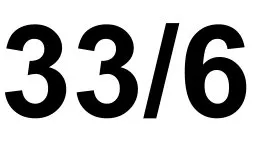
The number 33 is used by Ku Klux Klan adherents to signify the Ku Klux Klan. Since the 11th letter of the alphabet is K, three Ks signify "KKK" or the Ku Klux Klan. When using this reference, Klan members will frequently add the number 6 at the end, as in 33/6, because they think the Klan is currently in its sixth historical "era." Less commonly, some holdouts may still use the numeric code 33/5. Additional Images:
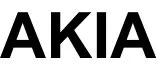
AKIA is Ku Klux Klan shorthand for "A Klansman I Am." It is related to another Klan acronym, AYAK ("Are You A Klansman?"). These are among the many acronyms developed by the Second Ku Klux Klan that emerged in 1915. Although the Second Ku Klux Klan did not survive, much of its terminology and many of its rituals did, and later Klan groups freely used them. Additional Images:
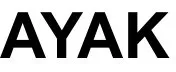
AYAK is Ku Klux Klan shorthand for "Are You A Klansman?" It is related to another Klan acronym, AKIA ("A Klansman I Am"). These are among the many acronyms developed by the Second Ku Klux Klan that emerged in 1915. Although the Second Ku Klux Klan did not survive, much of its terminology and many of its rituals did, and later Klan groups have freely used them. Additional Images:
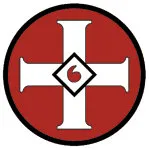
ALTERNATE NAMES: Ku Klux Klan, MIOAKGroup Status: Active (in that there are many active Ku Klux Klan groups)
For the past century, the primary symbol related to Ku Klux Klan groups (other than Klan robes themselves) is what Klan members may call the MIOAK (an acronym for "Mystic Insignia of a Klansman"). It is more commonly referred to as the "Blood Drop" Cross. It appears as a square white cross in black outline against a circular red background. In the middle of the cross is what appears…
ALTERNATE NAMES: Ku Klux Klan, MIOAK
Read more about Blood Drop Cross
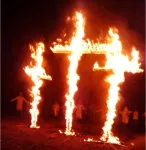
The image of the burning cross is one of the most potent hate symbols in the United States, popularized as a terror image by the Ku Klux Klan since the early 1900s. Cross-burnings (called "cross-lightings" by Ku Klux Klan groups, to make it seem as if they are not destroying a Christian cross) have long been used as a traditional symbol by Klan groups, used both in Klan rituals as well as in attempts to intimidate and terrorize victims of Klan groups. So widely associated with racial…

ALTERNATE NAMES: For God, Race and NationFGRN is a Ku Klux Klan acronym for "For God, Race and Nation," a common Klan slogan. It is one of a number of slogans, codes and rituals created by the Second Ku Klux Klan in the early 20th century. That Klan did not survive, but many of its codes and rituals were adopted by later Klan groups. In acronym form, the slogan is used primarily as a Klan identifier, typically appended at the end of on-line messages and postings. Additional Images:
ALTERNATE NAMES: For God, Race and Nation
Read more about FGRN

ITSUB is a Ku Klux Klan acronym for "In The Sacred Unfailing Being," a reference to God. It is one of many Klan acronyms created by the Second Ku Klux Klan that emerged in 1915. That Klan did not survive, but subsequent Ku Klux Klan groups continued many of its rituals and codes. Today, ITSUB has no real meaning or particular purpose and is typically used by Klan group members in on-line messages or posts solely as a way to identify themselves with the Ku Klux Klan. This has been the fate of a…

KABARK is a Ku Klux Klan acronym for "Konstantly Applied By All Regular Klansmen." It is one of many acronyms and codes developed by the Second Ku Klux Klan in the early 20th century. The Second Ku Klux Klan did not survive, but later Klan groups continued many of its codes and rituals. Today, KABARK is essentially meaningless and only used as a "sign off" in on-line messages by Klan group members, along with several other similar archaic acronyms. Additional Images:
KIGY is Ku Klux Klan shorthand for "Klansman I Greet You." It is one of many acronyms developed by the Second Ku Klux Klan that emerged in 1915. Although the Second Ku Klux Klan did not survive, much of its terminology and many of its rituals did, and later Klan groups freely used them. Additional Images:
KLASP is a Ku Klux Klan acronym for "Klannish Loyalty, A Sacred Principle." It is one of many Klan acronyms created by the Second Ku Klux Klan that emerged in 1915. That Klan did not survive, but subsequent Ku Klux Klan groups continued many of its rituals and codes. Today, KLASP has no real meaning or particular purpose and is typically used by Klan group members in on-line messages or posts solely as a way to identify themselves with the Ku Klux Klan. This has been the fate of a number of…
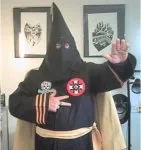
From its beginnings in the 1860s, the Ku Klux Klan has employed a variety of salutes and hand signs both public and private. Most of the hand signs and gestures used by the first and second Ku Klux Klans have fallen by the wayside over the years, except for the Klan salute, which dates back to 1915. It resembles a Nazi salute (which some Klan members will also use), except that it is performed with the left arm. Often Klan members will separate the fingers of their hand when making the salute …
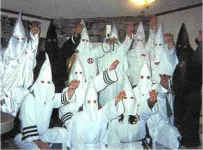
The hood and robes of Ku Klux Klan members are the most visible Klan symbol of all. Read about the history and current meanings behind the Klan’s robes.
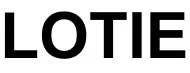
LOTIE is a Ku Klux Klan abbreviation for a "Lady Of The Invisible Empire," i.e., a female Klan member. It is one of many codes, phrases and rituals created by the Second Ku Klux Klan in the early 20th century. The Second Klan did not survive, but later Klan groups adopted many such codes and rituals, including LOTIE. Additional Images:
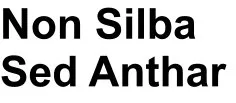
ALTERNATE NAMES: NSSANon Silba Sed Anthar is a Ku Klux Klan slogan intended to mean "Not Self, But Others." It looks like Latin but is a mix of Latin and Gothic. Occasionally it appears in acronym form as NSSA. The phrase is one of many phrases, codes and rituals developed by the Second Ku Klux Klan in the early 20th century. The Second Klan did not survive, but later Klan groups adopted many of its trappings. This is one of the more commonly used Klan slogans. Additional Images:
ALTERNATE NAMES: NSSA
Read more about Non Silba Sed Anthar
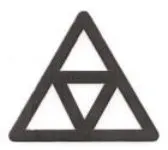
The triangular Ku Klux Klan symbol looks like a triangle within a triangle but is actually three letter K's aligned in a triangle and facing inwards.