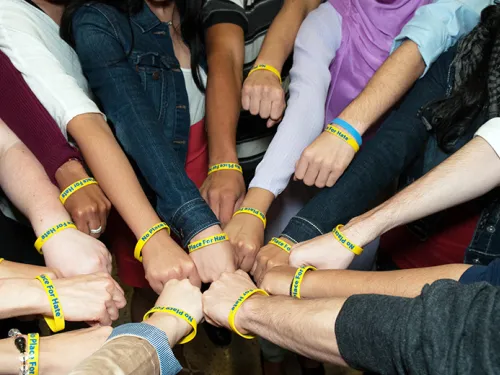


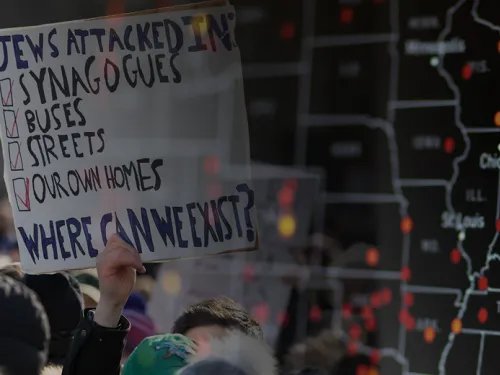

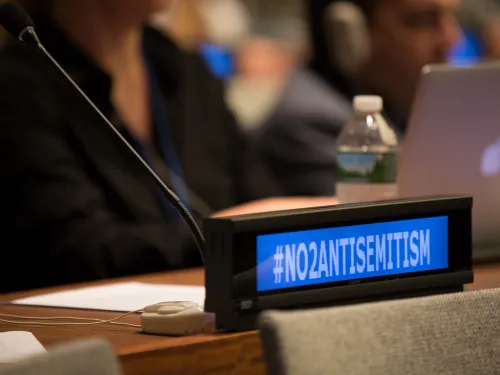
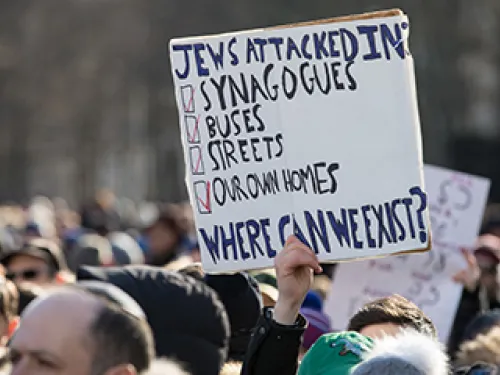



These suggested No Place for Hate® activities are differentiated for elementary, middle and high school students. The activities can be used as a follow-up to watching the webinar, “Connecting Stories and Legacies: A Conversation with Author Gordon Korman and Rachelle Goldstein” which aired on 2/11/25. To make this a NPFH activity towards designation, watch the video, engage students in a discussion using the discussion questions and do one of the additional activities included…
40 Results
Majority of Jewish parents surveyed report antisemitism in K-12 schools; and despite high public support for Holocaust and antisemitism education, less than 1/3 get it.
New York, NY, April 7, 2026 ... The Auschwitz-Birkenau Foundation has created a partnership with Echoes & Reflections, one of the most significant Holocaust education programs in the United States. As a result, American high school teachers will be able to use the "Auschwitz. In Front of Your Eyes" platform, which enables guided online tours for students of the Auschwitz Memorial and Museum. In 2026, the Foundation and Echoes & Reflections will provide groups of teachers with free…
New York, NY, July 18, 2025 … Jewish community organizations representing the majority of American Jewry today welcomed the decision by the National Education Association (NEA) Executive Committee and Board of Directors to reject a vote by the organization’s Representative Assembly to boycott ADL (Anti-Defamation League) educational materials on antisemitism and the Holocaust. ADL CEO Jonathan Greenblatt, American Jewish Committee (AJC) CEO Ted Deutch, Conference of Presidents of…
Jonathan Greenblatt
CEO and National Director
July 27, 2022
Dear Mr. Agrawal,
I am once again reaching out regarding Iranian Supreme Leader Ali Khamenei’s chronic violations of Twitter’s terms of service on his accounts of Iranian Supreme Leader Ali Khamenei. We ask that you de-platform him for his continued use of Twitter to promote antisemitism, hate, violence and Holocaust denial.
As I wrote in January 2021 to then Twitter CEO Jack Dorsey, Khamenei…
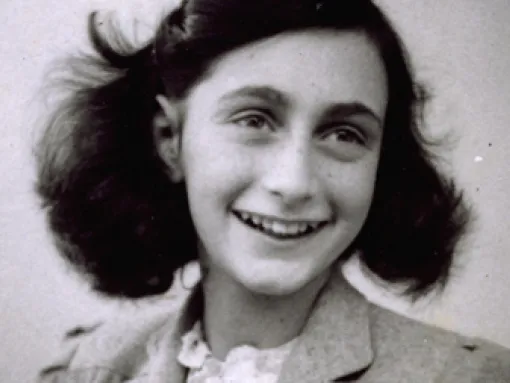
The author and publishers of a new book on Anne Frank's plight have turned one of the few at least partially upbeat stories of Jewish life and thought during the Holocaust into one of Jewish perfidy and treachery. The timing couldn’t be worse: antisemitism is flourishing once again, and Holocaust memory is diminishing.

Use these activities to bring the history, culture and experience of the AAPI (Asian American Pacific Islander) people and community to your classroom.
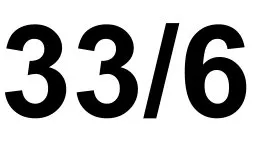
The number 33 is used by Ku Klux Klan adherents to signify the Ku Klux Klan. Since the 11th letter of the alphabet is K, three Ks signify "KKK" or the Ku Klux Klan. When using this reference, Klan members will frequently add the number 6 at the end, as in 33/6, because they think the Klan is currently in its sixth historical "era." Less commonly, some holdouts may still use the numeric code 33/5. Additional Images:
AKIA is Ku Klux Klan shorthand for "A Klansman I Am." It is related to another Klan acronym, AYAK ("Are You A Klansman?"). These are among the many acronyms developed by the Second Ku Klux Klan that emerged in 1915. Although the Second Ku Klux Klan did not survive, much of its terminology and many of its rituals did, and later Klan groups freely used them. Additional Images:
AYAK is Ku Klux Klan shorthand for "Are You A Klansman?" It is related to another Klan acronym, AKIA ("A Klansman I Am"). These are among the many acronyms developed by the Second Ku Klux Klan that emerged in 1915. Although the Second Ku Klux Klan did not survive, much of its terminology and many of its rituals did, and later Klan groups have freely used them. Additional Images:
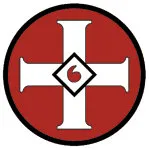
ALTERNATE NAMES: Ku Klux Klan, MIOAKGroup Status: Active (in that there are many active Ku Klux Klan groups)
For the past century, the primary symbol related to Ku Klux Klan groups (other than Klan robes themselves) is what Klan members may call the MIOAK (an acronym for "Mystic Insignia of a Klansman"). It is more commonly referred to as the "Blood Drop" Cross. It appears as a square white cross in black outline against a circular red background. In the middle of the cross is what appears…
ALTERNATE NAMES: Ku Klux Klan, MIOAK
Read more about Blood Drop Cross
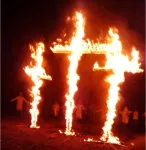
The image of the burning cross is one of the most potent hate symbols in the United States, popularized as a terror image by the Ku Klux Klan since the early 1900s. Cross-burnings (called "cross-lightings" by Ku Klux Klan groups, to make it seem as if they are not destroying a Christian cross) have long been used as a traditional symbol by Klan groups, used both in Klan rituals as well as in attempts to intimidate and terrorize victims of Klan groups. So widely associated with racial…

ALTERNATE NAMES: For God, Race and NationFGRN is a Ku Klux Klan acronym for "For God, Race and Nation," a common Klan slogan. It is one of a number of slogans, codes and rituals created by the Second Ku Klux Klan in the early 20th century. That Klan did not survive, but many of its codes and rituals were adopted by later Klan groups. In acronym form, the slogan is used primarily as a Klan identifier, typically appended at the end of on-line messages and postings. Additional Images:
ALTERNATE NAMES: For God, Race and Nation
Read more about FGRN

ITSUB is a Ku Klux Klan acronym for "In The Sacred Unfailing Being," a reference to God. It is one of many Klan acronyms created by the Second Ku Klux Klan that emerged in 1915. That Klan did not survive, but subsequent Ku Klux Klan groups continued many of its rituals and codes. Today, ITSUB has no real meaning or particular purpose and is typically used by Klan group members in on-line messages or posts solely as a way to identify themselves with the Ku Klux Klan. This has been the fate of a…

KABARK is a Ku Klux Klan acronym for "Konstantly Applied By All Regular Klansmen." It is one of many acronyms and codes developed by the Second Ku Klux Klan in the early 20th century. The Second Ku Klux Klan did not survive, but later Klan groups continued many of its codes and rituals. Today, KABARK is essentially meaningless and only used as a "sign off" in on-line messages by Klan group members, along with several other similar archaic acronyms. Additional Images:
KIGY is Ku Klux Klan shorthand for "Klansman I Greet You." It is one of many acronyms developed by the Second Ku Klux Klan that emerged in 1915. Although the Second Ku Klux Klan did not survive, much of its terminology and many of its rituals did, and later Klan groups freely used them. Additional Images:

KLASP is a Ku Klux Klan acronym for "Klannish Loyalty, A Sacred Principle." It is one of many Klan acronyms created by the Second Ku Klux Klan that emerged in 1915. That Klan did not survive, but subsequent Ku Klux Klan groups continued many of its rituals and codes. Today, KLASP has no real meaning or particular purpose and is typically used by Klan group members in on-line messages or posts solely as a way to identify themselves with the Ku Klux Klan. This has been the fate of a number of…
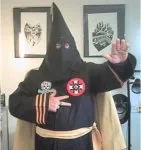
From its beginnings in the 1860s, the Ku Klux Klan has employed a variety of salutes and hand signs both public and private. Most of the hand signs and gestures used by the first and second Ku Klux Klans have fallen by the wayside over the years, except for the Klan salute, which dates back to 1915. It resembles a Nazi salute (which some Klan members will also use), except that it is performed with the left arm. Often Klan members will separate the fingers of their hand when making the salute …
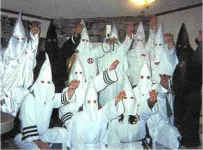
The hood and robes of Ku Klux Klan members are the most visible Klan symbol of all. Read about the history and current meanings behind the Klan’s robes.
LOTIE is a Ku Klux Klan abbreviation for a "Lady Of The Invisible Empire," i.e., a female Klan member. It is one of many codes, phrases and rituals created by the Second Ku Klux Klan in the early 20th century. The Second Klan did not survive, but later Klan groups adopted many such codes and rituals, including LOTIE. Additional Images: