

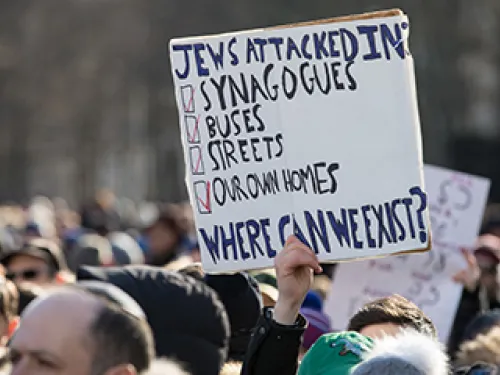
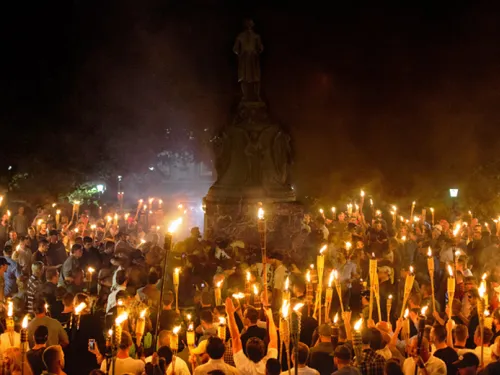




By Jonathan Greenblatt CEO of the Anti-Defamation League As the still fairly new CEO of the Anti-Defamation League (ADL), I’ve been on the job less than one year. I’m frequently asked about our current position on historical League decisions. One of those crucial questions is where ADL stands with regards to recognition of the Armenian Genocide. My family was directly impacted by the Holocaust. Given that profoundly personal experience, I appreciate the pain of those who…
28 Results
by: Shaya Lerner On May 14, 2016, the second international Holocaust Cartoon Contest exhibition will open in Iran, with the first place winner – reportedly to be announced in June – receiving a large cash prize. According to reports in the Iranian press, the May 14th date was chosen to coincide with Nakba Day (catastrophe day), the term used by Palestinian to refer to the events surrounding Israel’s independence in 1948. The contest reportedly received over 800…
by: Shaya Lerner Despite the international community’s reengagement with a more “open” and “moderate” Iran, some things in Iranian society haven’t changed, including the prevalence of Holocaust mockery and denial. While President Rouhani hasn’t touted the issue like his predecessor Ahmadinejad had, recent announcements indicate that the questioning of the Holocaust is very much alive and well within Iranian society. In December, the Tehran…

Share and discuss with middle and high school students war-time experiences of three child survivors and how the Holocaust affected them.

Learn about International Holocaust Remembrance Day, a date that marks the liberation of Auschwitz-Birkenau and is meant to honor the victims of Nazism.
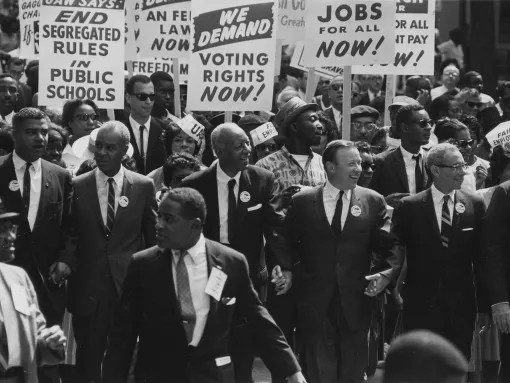
The Civil Rights Movement of the 1950’s and 1960’s came about out of the need and desire for equality and freedom for African Americans and other people of color. Nearly one hundred years after slavery was abolished, there was widespread segregation, discrimination, disenfranchisement and racially motivated violence that permeated all personal and structural aspects of life for black people. “Jim Crow” laws at the local and state levels barred African Americans from…
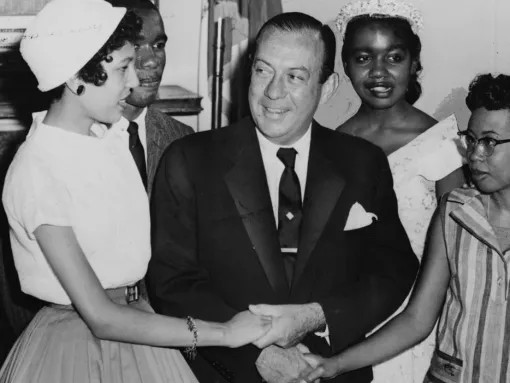
Minnijean Brown, Elizabeth Eckford, Carlotta Walls, Mayor Wagner, Thelma Mothershed, Gloria Ray, Terrance Roberts, Ernest Green, Melba Pattilo, Jefferson Thomas.
On September 23, 1957 in Little Rock, Arkansas, these nine African-American students quietly slipped into Central High School through the side door with the assistance of the city’s police, while an angry white mob numbering 1,000 swarmed the front of the school to await their arrival. Upon learning of their entry, the…
The Civil Rights Act of 1964 was signed into law by President Lyndon Johnson on July 2, 1964. The Act prohibited discrimination in public places, provided for the integration of schools and other public facilities and made employment discrimination illegal based on race, color, religion, sex or national origin. The document was the most sweeping civil rights legislation since Reconstruction. As we commemorate the anniversary of the Civil Rights Act, we have an opportunity to teach and learn…