Despite game companies having policies prohibiting hate, researchers easily found usernames in 5 categories of hate across 5 popular online multiplayer games.
Six Things ADL is Watching Following Meta's Threads Launch
Article
Threads raises concerns similar to other Meta platforms on user safety, policies on hate, harassment, and extremism, transparency, and election integrity.
Threads of Hate: How Twitter's Content Moderation Misses the Mark
Article
Twitter’s decision to reinstate influential banned accounts allowed CTS to examine how they act as nodes in broader networks and exploit inadequate policies
Americans’ Views on Generative Artificial Intelligence, Hate and Harassment
Article
Generative Artificial Intelligence (GAI) has dominated news headlines for its potential to transform how we work, write, and play. For example, OpenAI’s ChatGPT allows people to ask various questions, summarize a book or write a new song in the style of their favorite musical artist. AI-enhanced search tools return summaries of online content, rather than a list of links to different webpages. Other tools create realistic photos or pieces of artwork from a description. Some tools create…
Evaluating Twitter's Policies Six Months After Elon Musk's Purchase
Article
Policy and enforcement developments since Elon Musk acquisition of Twitter and what they mean for enforcement of hate speech policies and protecting users.
Social Media Election Policies: The Good, the Bad and the Misinformed
Article
False and misleading social media harms elections, undermines public trust, normalizes baseless challenges to elections, stokes harassment and incites violence.
ADL’s analysis found Meta has accepted large sums of money for ads on hateful topics such as antisemitism and transphobia. In some cases, Meta even accepted money for ads that violated its hate speech policy.
Major Platforms’ Midterm Election Policies: Are They Enough?
Article
Summary
The United States midterm electoral campaigns are in full force as candidates prepare advertisements and voter outreach. Social media is an integral part of their campaigning as more than half of all Americans get news from a social media platform.
But false or misleading information (including misinformation, spread without malice or coordination, and disinformation, purposely created to manipulate or cause harm) runs rampant on platforms, subverting democracy and leading…
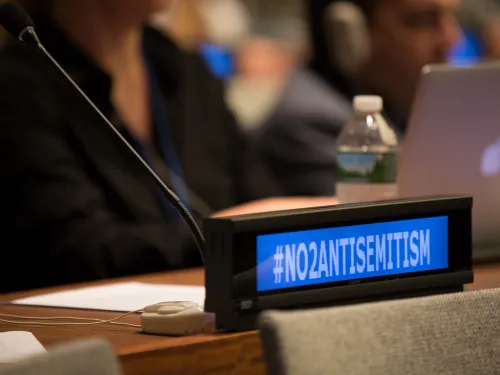
Remarks by Jonathan Greenblatt to the Inter-Parliamentary Task Force to Combat Online Antisemitism
News
Good evening and thank you for being a part of this important gathering of the Inter-Parliamentary Task Force to Combat Online Antisemitism.
I’m delighted to see so many friends in this room tonight. I want to particularly thank Task Force co-chairs U.S. Rep. Debbie Wasserman Schultz and Canadian Member of Parliament Anthony Housefather for organizing this critically important summit that challenges us to ask hard questions about the evolution and proliferation of online antisemitism…
How A Texas Teen Turned Bias and Body-Shaming into Advocacy and Action
Article
Olivia Julianna (who uses only her first and middle name publicly to protect her privacy) has been an activist for several years, advocating voting rights and reproductive-health care. Like many in her generation, she found the political side of TikTok where young people post about important issues facing them. Olivia is involved with Gen-Z for Change, a nonprofit organization leveraging social media to promote civil discourse and political action on a variety of topics including…
Swatting is the deliberate and malicious act of reporting a false crime or emergency to evoke an aggressive response (often a SWAT team) from a law enforcement agency to a target's residence or place of work to harass and intimidate them.
Alarmingly, swatting appears to be on the rise. Kevin Kolbye, a former FBI agent with expertise in swatting, estimates incidents have jumped from 400 cases in 2011 to over 1,000 in 2019. Unfortunately, the actual number is unknown because the FBI does not…
Twitter’s Failure to Enforce Its Policy Against Antisemitism
Article
An investigation from ADL’s Center for Technology and Society (CTS) found Twitter did not remove over 200 blatantly antisemitic tweets accusing Jewish people of pedophilia, invoking Holocaust denial, and sharing oft-repeated conspiracy theories. To test Twitter’s enforcement of its policies on antisemitism, CTS reported 225 strongly antisemitic tweets over nine weeks through ongoing communications with the platform. Of the reported tweets, Twitter only removed 11, or 5% of the…
Repeat Liars: Falsehoods Around Buffalo Shooting and the 2020 Election
Article
Whether it is about a global pandemic, the 2020 presidential election, the Russian invasion of Ukraine, or the latest mass shooting, lies continue to thrive on social media platforms. According to a 2021 poll by the Pew Research Center, nearly half of Americans get their news from social media. While many people feel confident in their media literacy, YouGov found that only 4% of those surveyed could correctly distinguish false news stories from true ones.
In order to assess platforms…
Deplatform Tucker Carlson and the "Great Replacement" Theory
Article
In the wake of the horrific racist massacre in Buffalo, NY, Stop Hate for Profit is calling on mainstream social media platforms Twitter, Facebook, YouTube, Twitch, Discord, and Reddit to immediately stop the spread of hateful white supremacist rhetoric that has incited acts of violence by permanently banning repeat perpetrators like Tucker Carlson, Laura Ingraham and others from their platforms and enforcing their own hate speech policies with regard to the Great Replacement theory and white supremacy. This article describes the forms that the Great Replacement Theory takes on these platforms and the platform policies they are violating.