Attitudes Toward Jews and Israel on California Campuses: Results from a New Survey
Report
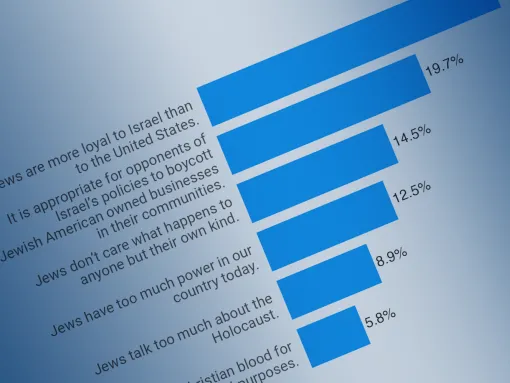
Sponsored by CAR, Dr. Jeffrey Kopstein, Ana Schugurensky and Dr. Rachel Shenhav-Goldberg investigated anti-Jewish and anti-Israel attitudes on four UC campuses.
ADL Welcomes Introduction of Federal Buffer Zone Legislation to Protect Safe Access to Synagogues and Houses of Worship
Press Release
New York, NY, April 24, 2026 … ADL (the Anti-Defamation League) today welcomed the introduction of the federal Safeguarding Access to Congregations and Religious Establishments from Disruption (SACRED) Act, a bipartisan bill that protects safe access to houses of worship by establishing a 100-foot “safe access” zone around churches, synagogues, mosques and other religious locations. The SACRED Act would create federal penalties for targeted harassment and…
ADL, Brandeis Center, Mayer Brown, and StandWithUs Welcome Concord-Carlisle Regional School District’s Settlement to Address Antisemitism
Press Release
New York, NY, April 20, 2026 — ADL (the Anti-Defamation League), the Louis D. Brandeis Center for Human Rights Under Law, and a pro bono team at the law firm Mayer Brown welcome the April 15 resolution agreement between the Concord-Carlisle Regional School District and the U.S. Department of Justice requiring the district to take steps to address antisemitism and protect Jewish students. The agreement follows a federal civil rights filing by attorneys from ADL, Brandeis Center, and…
ADL and Benesch Sue Oakland Cafe for Discriminating Against Jewish Customer
Press Release
Cafe owner and employees berate customer for being Jewish and refuse him service February 27, 2025 -- San Francisco -- ADL (the Anti-Defamation League) and Benesch, Friedlander, Coplan & Aronoff LLP (Benesch) today filed a federal lawsuit against the operators of Jerusalem Coffee House of Oakland Calif., on behalf of a Jewish customer, Michael Radice, alleging the cafe violated his civil rights and denied him full and equal accommodations by refusing him service simply for being…
Opinion: Here’s hard proof that employers are discriminating against Jews
News
By Jonathan A. Greenblatt Applying for a job is hard. Whether you’re already employed or not, whether it’s your first job out of school or you’ve been in the workforce for decades, it takes time, it takes energy, and it takes courage. Candidates will pore over their resumés, practice for interviews, ask trusted friends and mentors how to put their best self forward. Discrimination against Jewish job applicants: But it turns out the name atop that resumé sadly…
Declaración de la ADL sobre el pogromo contemporáneo en Ámsterdam
Press Release
Miles de israelíes perseguidos y brutalmente agredidos en ataque antisemita en Ámsterdam Nueva York, NY, 8 de noviembre de 2024… La Liga Antidifamación (ADL) expresó hoy su profundo horror e indignación por el violento, generalizado y aparentemente premeditado y coordinado ataque antisemita de anoche contra los aficionados al fútbol israelíes en Ámsterdam, tras el partido entre el Maccabi Tel Aviv y el Ajax. Miles de israel…
ADL Statement Regarding Modern-Day Pogrom in Amsterdam
Press Release
Scores of Israelis Hunted Down, Brutally Assaulted in Antisemitic Attack in Amsterdam New York, NY, November 8, 2024 ... ADL (the Anti-Defamation League) today expressed its deep horror and outrage at the violent, widespread, and apparently premeditated and coordinated antisemitic attack on Israeli soccer fans in Amsterdam, following a game between Maccabi Tel Aviv and Ajax last night. Scores of Israelis were hunted down, brutally assaulted and injured. The attackers’…
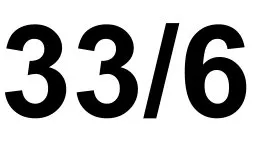
The number 33 is used by Ku Klux Klan adherents to signify the Ku Klux Klan. Since the 11th letter of the alphabet is K, three Ks signify "KKK" or the Ku Klux Klan. When using this reference, Klan members will frequently add the number 6 at the end, as in 33/6, because they think the Klan is currently in its sixth historical "era." Less commonly, some holdouts may still use the numeric code 33/5. Additional Images:
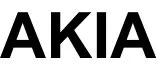
AKIA is Ku Klux Klan shorthand for "A Klansman I Am." It is related to another Klan acronym, AYAK ("Are You A Klansman?"). These are among the many acronyms developed by the Second Ku Klux Klan that emerged in 1915. Although the Second Ku Klux Klan did not survive, much of its terminology and many of its rituals did, and later Klan groups freely used them. Additional Images:
AYAK is Ku Klux Klan shorthand for "Are You A Klansman?" It is related to another Klan acronym, AKIA ("A Klansman I Am"). These are among the many acronyms developed by the Second Ku Klux Klan that emerged in 1915. Although the Second Ku Klux Klan did not survive, much of its terminology and many of its rituals did, and later Klan groups have freely used them. Additional Images:
ALTERNATE NAMES: Ku Klux Klan, MIOAKGroup Status: Active (in that there are many active Ku Klux Klan groups)
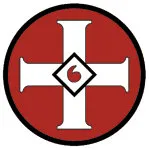
For the past century, the primary symbol related to Ku Klux Klan groups (other than Klan robes themselves) is what Klan members may call the MIOAK (an acronym for "Mystic Insignia of a Klansman"). It is more commonly referred to as the "Blood Drop" Cross. It appears as a square white cross in black outline against a circular red background. In the middle of the cross is what appears…
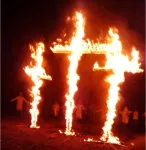
The image of the burning cross is one of the most potent hate symbols in the United States, popularized as a terror image by the Ku Klux Klan since the early 1900s. Cross-burnings (called "cross-lightings" by Ku Klux Klan groups, to make it seem as if they are not destroying a Christian cross) have long been used as a traditional symbol by Klan groups, used both in Klan rituals as well as in attempts to intimidate and terrorize victims of Klan groups. So widely associated with racial…
ALTERNATE NAMES: For God, Race and NationFGRN is a Ku Klux Klan acronym for "For God, Race and Nation," a common Klan slogan. It is one of a number of slogans, codes and rituals created by the Second Ku Klux Klan in the early 20th century. That Klan did not survive, but many of its codes and rituals were adopted by later Klan groups. In acronym form, the slogan is used primarily as a Klan identifier, typically appended at the end of on-line messages and postings. Additional Images:
ITSUB is a Ku Klux Klan acronym for "In The Sacred Unfailing Being," a reference to God. It is one of many Klan acronyms created by the Second Ku Klux Klan that emerged in 1915. That Klan did not survive, but subsequent Ku Klux Klan groups continued many of its rituals and codes. Today, ITSUB has no real meaning or particular purpose and is typically used by Klan group members in on-line messages or posts solely as a way to identify themselves with the Ku Klux Klan. This has been the fate of a…
KABARK is a Ku Klux Klan acronym for "Konstantly Applied By All Regular Klansmen." It is one of many acronyms and codes developed by the Second Ku Klux Klan in the early 20th century. The Second Ku Klux Klan did not survive, but later Klan groups continued many of its codes and rituals. Today, KABARK is essentially meaningless and only used as a "sign off" in on-line messages by Klan group members, along with several other similar archaic acronyms. Additional Images:
KIGY is Ku Klux Klan shorthand for "Klansman I Greet You." It is one of many acronyms developed by the Second Ku Klux Klan that emerged in 1915. Although the Second Ku Klux Klan did not survive, much of its terminology and many of its rituals did, and later Klan groups freely used them. Additional Images:
KLASP is a Ku Klux Klan acronym for "Klannish Loyalty, A Sacred Principle." It is one of many Klan acronyms created by the Second Ku Klux Klan that emerged in 1915. That Klan did not survive, but subsequent Ku Klux Klan groups continued many of its rituals and codes. Today, KLASP has no real meaning or particular purpose and is typically used by Klan group members in on-line messages or posts solely as a way to identify themselves with the Ku Klux Klan. This has been the fate of a number of…
From its beginnings in the 1860s, the Ku Klux Klan has employed a variety of salutes and hand signs both public and private. Most of the hand signs and gestures used by the first and second Ku Klux Klans have fallen by the wayside over the years, except for the Klan salute, which dates back to 1915. It resembles a Nazi salute (which some Klan members will also use), except that it is performed with the left arm. Often Klan members will separate the fingers of their hand when making the salute …
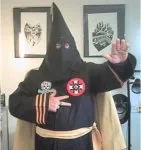
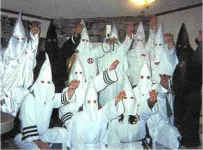
The hood and robes of Ku Klux Klan members are the most visible Klan symbol of all. Read about the history and current meanings behind the Klan’s robes.
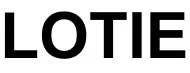
LOTIE is a Ku Klux Klan abbreviation for a "Lady Of The Invisible Empire," i.e., a female Klan member. It is one of many codes, phrases and rituals created by the Second Ku Klux Klan in the early 20th century. The Second Klan did not survive, but later Klan groups adopted many such codes and rituals, including LOTIE. Additional Images: