


For Educators In this podcast, Duncan Tonatiuh talks about meeting Sylvia Mendez and how that inspired him to write Separate Is Never Equal, his love of art and writing and how his dual citizenship identity shapes what he writes.
Duncan Tonatiuh is an award winning children's book author and illustrator. He was born in Mexico City and grew up in San Miguel de Allende. He graduated from Parsons New School for Design and Eugene Lang College in NYC. Duncan has…
5 Results
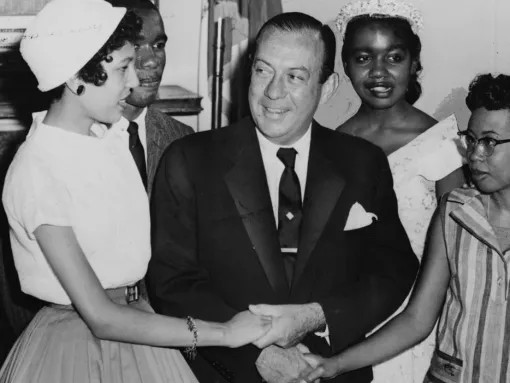
Minnijean Brown, Elizabeth Eckford, Carlotta Walls, Mayor Wagner, Thelma Mothershed, Gloria Ray, Terrance Roberts, Ernest Green, Melba Pattilo, Jefferson Thomas.
On September 23, 1957 in Little Rock, Arkansas, these nine African-American students quietly slipped into Central High School through the side door with the assistance of the city’s police, while an angry white mob numbering 1,000 swarmed the front of the school to await their arrival. Upon learning of their entry, the…

More than sixty-five years after Brown v. Board of Education, the promise of equal access to quality education remains unfulfilled. School expulsions and suspensions are among the best predictors of who will drop out of high school and African American students are three more likely to be suspended or expelled than their white peers.
In January 2014, the Department of Education and Department of Justice issued watershed guidance on school discipline with the intent to …
The Civil Rights Act of 1964 was signed into law by President Lyndon Johnson on July 2, 1964. The Act prohibited discrimination in public places, provided for the integration of schools and other public facilities and made employment discrimination illegal based on race, color, religion, sex or national origin. The document was the most sweeping civil rights legislation since Reconstruction. As we commemorate the anniversary of the Civil Rights Act, we have an opportunity to teach and learn…
From Bloody Sunday to the Voting Rights Act: How One Day Changed the Course of Civil Rights History
March 7, 1965 — a day that would become known as Bloody Sunday — forever changed the course of American history. That day the nation’s attention turned to Selma, Alabama, where state troopers and a sheriff’s posse brutally attacked 575 demonstrators attempting to march peacefully to Montgomery. The marchers had gathered for two purposes: to advocate for voting…