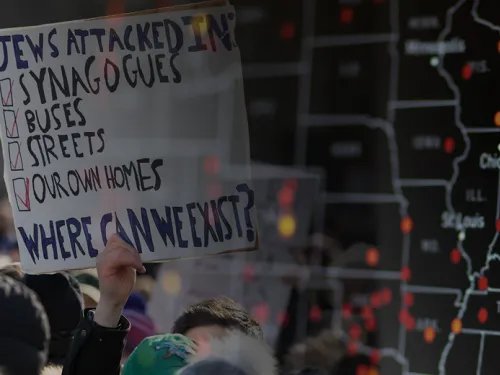


This ADL/AEN resource provides background information regarding the “scholasticide” charge against Israel, including its origins and recent efforts to promote it.
20 Results

In a world that is increasingly connected through social media, educators often incorporate current events into instruction. While this is an important tool for educators to make learning feel relevant and current for students, it also must be done with thought and care. Many curriculum offerings claim to offer educators resources and guidance on integrating complex current events into their classrooms, like the Israeli-Palestinian conflict. Sometimes these offerings, while claiming to provide…

Educators surveyed in a 2025 RAND study said that after school curricula and U.S. Holocaust Memorial Museum materials, YouTube is their most-used supplement for teaching the Holocaust and related Jewish topics. Although its videos are free and visually engaging, their quality varies; for example, Vox’s “The Israel-Palestine Conflict: A Brief, Simple History” can appear more reliable than it is. Vox itself is an American news and opinion website that leans towards the…

In recent years, the education landscape has changed dramatically. With the rise of AI platforms like ChatGPT and resource sharing hubs like Teachers Pay Teachers, there are many organizations and resources that claim to offer quality material—often at no cost. The rise of these platforms coincides with a change in trends for educators. According to a report from Education Week, the average teacher uses five supplemental resources and two core curricula sources. The report goes on…
In response to mounting incidents, ADL and the Academic Engagement Network (AEN) have developed this toolkit to help address antisemitism and anti-Israel bias and to foster inclusive academic spaces that welcome diverse perspectives on Israel and the broader Middle East. It is intended for Jewish and Zionist faculty, staff and others experiencing antisemitism and anti-Israel bias in their professional academic associations and scholarly societies. This resource includes real-world…

There are many benefits of humor. A good joke can ease tension in a stressful situation. Humor can connect people and bring them together. Jokes can bring levity to a situation that begs for lightheartedness. Being funny can signal to others who you are. Humor can even open a conversation that previously felt closed or off-limits.
However, jokes and humor, when they target social identity groups, can do the opposite. They can make people feel unsafe, disconnected, excluded and…
Definiciones de antisemitismo, antisionismo y prejuicio antiisraelí comúnmente utilizadas y malinterpretadas.
Estrategias para estar preparado ante situaciones antisemitas o antiisraelíes de la vida real a las que podrías enfrentarte y que han ocurrido en campus universitarios.
Si tú u otro estudiante judío es objeto de ataques en el campus, pueden estar preparados. Conoce a quién dirigirte, qué hacer y qué no hacer.
Preguntas frecuentes sobre la libertad de expresión, su protección y las diferencias entre universidades públicas y privadas.
Cómo mantener un debate concienzudo sobre el conflicto palestino-israelí y evitar los errores más comunes que podrían invocar el antisemitismo, el sesgo o la intolerancia.
Medidas proactivas que puedes tomar para disminuir el impacto de la actividad antisraelí en el campus y estar preparado en caso de tener que responder.
Consejos sobre cómo participar y desvincularte en la lucha contra el antisemitismo, los prejuicios contra Israel y el odio en las redes sociales.
Learn tips on how to have conscientious discussions about this complex issue and how to avoid common pitfalls that could invoke antisemitism, bias or bigotry.
ADL has developed resources to help you respond to antisemitic incidents and anti-Israel bias. Explore these tools and learn more.
Definitions of antisemitism, anti-Zionism and anti-Israel bias.
Social media is a hotbed of antisemitism, anti-Israel hate, Holocaust denial and distortion and other conspiracy theories. Check out our tips on how to engage and disengage in the fight against antisemitism, anti-Israel bias, and hate on social media.
Strategies on how to be prepared for antisemitic or anti-Israel situation on campus, based on real life incidents
In the 1930s, the dean of Yale University’s medical school — who was Jewish himself — reportedly advised his admissions team, “Never admit more than five Jews, take only two Italian Catholics, and take no blacks at all.”
The American college campus has come a long way in the past century. Colleges are more diverse, and there are greater efforts to create inclusive environments whereby all students feel comfortable on campus. But that does not mean you…
What is the source of our free speech rights? Free speech rights emanate from the First Amendment to the U.S. Constitution[1] and from state constitutions. The U.S. Constitution limits the government’s ability to regulate speech based on content and it applies to all public colleges and universities. It serves as a floor, not a ceiling. State constitutions may grant more robust free speech rights than the U.S. Constitution, but never fewer. Is there a distinction between private and…