


New York, NY, April 24, 2026 … ADL (the Anti-Defamation League) today welcomed the introduction of the federal Safeguarding Access to Congregations and Religious Establishments from Disruption (SACRED) Act, a bipartisan bill that protects safe access to houses of worship by establishing a 100-foot “safe access” zone around churches, synagogues, mosques and other religious locations. The SACRED Act would create federal penalties for targeted harassment and…
10 Results
New York, NY, March 11, 2026 – ADL (the Anti-Defamation League) today announced that Emmanuel Acho will receive the first-ever ADL Ally Award at the 2026 Never Is Now Summit. A New York Times bestselling author, Emmy Award winner and host, Acho has built a powerful platform by fostering honest dialogue, challenging hate and encouraging people to engage across differences with empathy and integrity. His work exemplifies a core theme of this year’s Never Is Now Summit:…
October 16, 2025… Washington D.C. — ADL (the Anti-Defamation League) and the National Hispanic Christian Leadership Conference (NHCLC), the largest Latino Christian organization and affiliated with over 42,000 churches in the U.S., today announced a historic new partnership aimed at combating antisemitism and anti-Zionism, and deepening Latino-Jewish solidarity across communities of faith. Through this new collaboration, the organizations will co-develop resources…
New York, NY, December 19, 2024 … ADL (the Anti-Defamation League) today welcomed the House Republican leadership’s report concluding their investigation into the alarming surge of antisemitism since Hamas’s terrorist attack on October 7, 2023. The committee’s investigation found that several universities failed to stop antisemitism on their campuses, likely violating Title VI of the Civil Rights Act of 1964. Additionally, the report found that several American…
Remarks as delivered June 27th, 2024 Thank you- I join you all here this morning on behalf of ADL, the oldest anti-hate organization in the United States, alongside my good friend Marc Morial, President of the National Urban League, and our partners - Assembly members Brian Cunningham, Nily Rozic, Grace Lee, Jennifer Rajkumar and Pastor Johnnie Green. In addition. We are very grateful to Dr. Hazel Dukes of the NY NAACP, an icon of the civil rights movement for lending her strong words of…
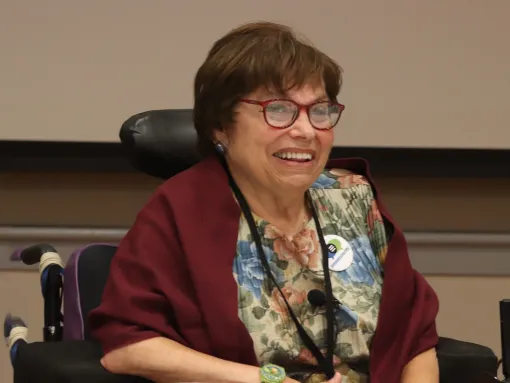
Teach students about disability rights activist Judy Heumann and what work in schools and communities still remains.
Civics Lesson
GRADE LEVEL: High School How Were Youth Involved in the Civil Rights Movement?
Throughout history, young people have stepped up and into leadership roles during different civil rights and social movements. This was never more evident than in the Civil Rights Movement, where young people were on the frontlines of the Montgomery bus boycotts, Freedom Rides and sit-ins. Given that student activism is on the rise again across the U.S., understanding how those young voices…
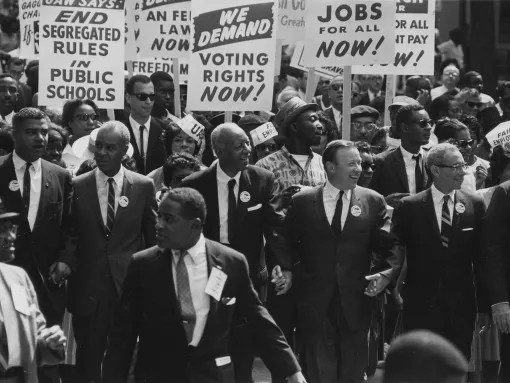
The Civil Rights Movement of the 1950’s and 1960’s came about out of the need and desire for equality and freedom for African Americans and other people of color. Nearly one hundred years after slavery was abolished, there was widespread segregation, discrimination, disenfranchisement and racially motivated violence that permeated all personal and structural aspects of life for black people. “Jim Crow” laws at the local and state levels barred African Americans from…
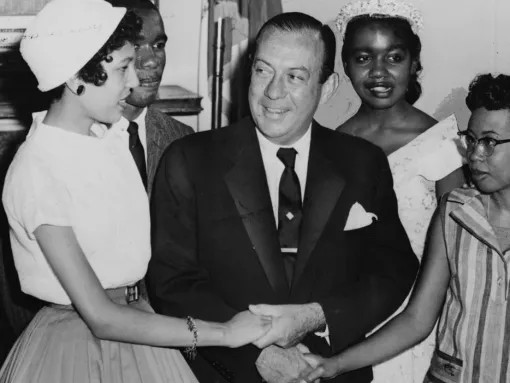
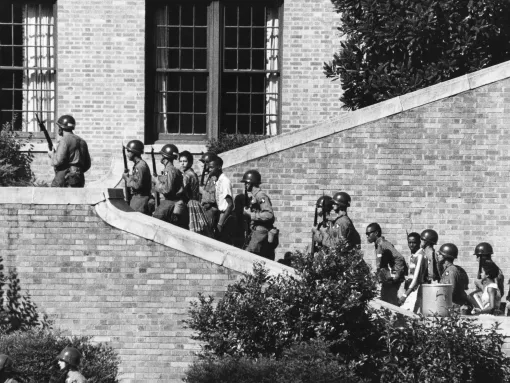
Minnijean Brown, Elizabeth Eckford, Carlotta Walls, Mayor Wagner, Thelma Mothershed, Gloria Ray, Terrance Roberts, Ernest Green, Melba Pattilo, Jefferson Thomas.
On September 23, 1957 in Little Rock, Arkansas, these nine African-American students quietly slipped into Central High School through the side door with the assistance of the city’s police, while an angry white mob numbering 1,000 swarmed the front of the school to await their arrival. Upon learning of their entry, the…
The Civil Rights Act of 1964 was signed into law by President Lyndon Johnson on July 2, 1964. The Act prohibited discrimination in public places, provided for the integration of schools and other public facilities and made employment discrimination illegal based on race, color, religion, sex or national origin. The document was the most sweeping civil rights legislation since Reconstruction. As we commemorate the anniversary of the Civil Rights Act, we have an opportunity to teach and learn…