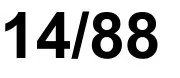
1488: 14 words and the 8th letter of the alphabet. Combined this creates a powerful symbol for white supremacists. Find out the true meaning of these numbers.
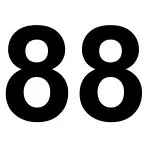
88 is a white supremacist numerical code for Heil Hitler. Read more about the meaning behind the numbers, as well as how it’s used in non-extremist forms.
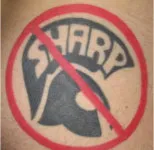
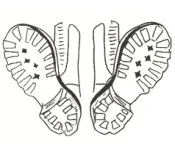
Racist skinheads view anti-racist skinheads (typically known as SHARPs, an acronym for Skin Heads Against Racial Prejudice) as enemies and frequently attack them (and vice versa). Racist skinheads also commonly create anti-SHARP imagery that typically demeans SHARPs or implies violence should be used against them. Additional Images:
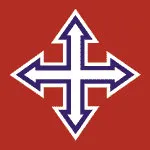
The Arrow Cross symbol derives from the Hungarian fascist political party known as the Arrow Cross Party that was active during 1935-45. Since then, various neo-Nazis and white supremacists have used the symbol themselves, either generically or as part of the logo of a specific hate group.
November 24, 2020 By Vegas Tenold, Investigative Researcher, ADL Center on Extremism
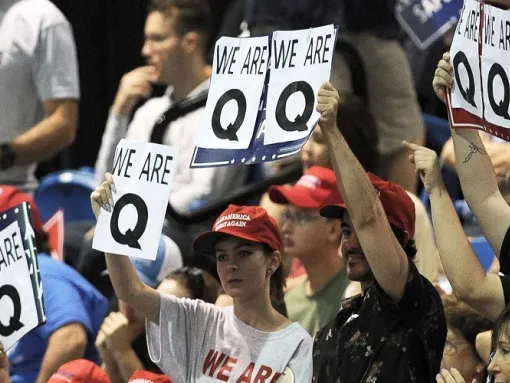
President Trump’s loss to President-elect Joe Biden in the 2020 U.S. presidential election has presented the QAnon movement with a conundrum -- and a test of its ability to survive in the face of total cognitive dissonance.
For many QAnon believers, who subscribed to a movement founded on the notion of President Trump’s utter infallibility, the idea of an electoral loss was simply…
Extremist Trolls are Targeting Omegle Users with Virulent Racism, Antisemitism
Article
November 24, 2020 UPDATE:
In July 2021, during a investigative radio show and podcast, Alex Mann, an Australian journalist for ABC’s Background Briefing, identified CatboyKami (aka Philip Hedley) as Tor Gustafsson Brookes.
Extremists are constantly adapting and finding ways to reach new audiences, spread and spew their hate and create online content. Their latest tactic involves the use of Omegle, a free online chat service that randomly pairs anonymous users for…
ALTERNATE NAMES: Ku Klux Klan, MIOAKGroup Status: Active (in that there are many active Ku Klux Klan groups)
For the past century, the primary symbol related to Ku Klux Klan groups (other than Klan robes themselves) is what Klan members may call the MIOAK (an acronym for "Mystic Insignia of a Klansman"). It is more commonly referred to as the "Blood Drop" Cross. It appears as a square white cross in black outline against a circular red background. In the middle of the cross is what appears…
Group Status: Legacy (the group is no longer active but some symbols may remain as tattoos, graffiti, etc.)
The term "blue-eyed devil" is a racial epithet originating in Asia directed against people of European ancestry. Some white supremacists have adopted the term in recent decades and may refer to themselves as blue-eyed devils.
In 1995, a white power music band emerged in Delaware that called itself the Blue Eyed Devils. The band created a distinctive logo consisting of a rounded…
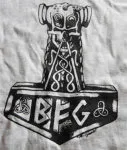
Group Status: Legacy (the group is no longer active, but some symbols may remain as tattoos, graffiti, etc.) Bound for Glory is the name of a longstanding white power music band (dating back to 1989) from Minneapolis. It is popular among white supremacists. The main symbol associated with the band is a Thor's Hammer containing the band's initials. Also common are the band's initials in or superimposed over an Iron Cross. Both images derive from albums released by the group. As of 2025, the…
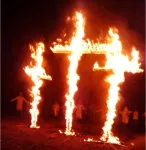
The image of the burning cross is one of the most potent hate symbols in the United States, popularized as a terror image by the Ku Klux Klan since the early 1900s. Cross-burnings (called "cross-lightings" by Ku Klux Klan groups, to make it seem as if they are not destroying a Christian cross) have long been used as a traditional symbol by Klan groups, used both in Klan rituals as well as in attempts to intimidate and terrorize victims of Klan groups. So widely associated with racial…
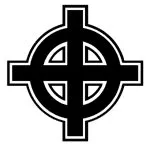
ALTERNATE NAMES: Odin’s Cross, Sun Cross, Wheel CrossThe white supremacist version of the Celtic Cross, which consists of a square cross interlocking with or surrounded by a circle, is one of the most important and commonly used white supremacist symbols. Although usually called a Celtic Cross by white supremacists, its origins date to the pre-Christian "sun cross" or "wheel cross" in ancient Europe. Norwegian Nazis used a version of the symbol in the 1930s and 1940s. After World War II,…
ALTERNATE NAMES: Odin’s Cross, Sun Cross, Wheel Cross
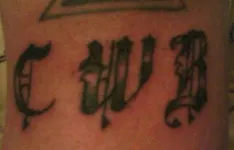
The term "Crazy White Boy" (as well as its initials, CWB) is a phrase used generically by some white supremacists (often in tattoo form) to identify themselves. It is also commonly used as a name for white gangs. There have been a number of Crazy White Boy/s gangs in different places around the United States, in the streets or in prisons, over the years. Most are small, locally-oriented, and unconnected to other, similarly named groups. Variants of this term include…
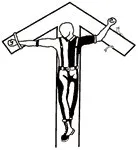
The crucified skinhead image is a longstanding symbol used by the entire skinhead subculture (i.e., both racist and non-racist or anti-racist skinheads). Skinheads often use it to convey a sense of persecution or alienation or that society is arrayed against them. In isolation, the crucified skinhead symbol itself cannot be described as a hate symbol. But racist skinheads often adorn their versions of the crucified skinhead with other hate symbols or, in many cases, replace the cross with some…
The "echo," as it is sometimes called, is the online use by antisemites of multiple parentheses around a person's name to indicate that they are Jewish or, when used around a phrase or term, such as (((banker))), to imply that the word "Jewish" should be added to it.
November 20, 2020 By David Andrew Weinberg
The Yemeni Embassy in Washington recently released a report featuring primary source documents on the core ideology of the Houthi insurgents who seized Yemen’s capital in 2014. That report, authored by Embassy official Salem Baafi, makes a case that antisemitism and other forms of hate form an essential part of the worldview and motivation of Yemen’s Houthi rebels.
The Houthis’ oft-invoked slogan is itself antisemitic…
Since World War II, neo-Nazis and some other white supremacists have adopted the image of a World War II-era German soldier as a symbol. In particular, images of Waffen SS soldiers (perceived as Hitler's elite "supermen") are popular. A popular variation is a tattoo depicting a Viking warrior, a Waffen SS soldier, and a racist skinhead side by side; such images associate the modern racist skinhead with his perceived "white warrior" forebears. Additional Images:
White supremacists use the letter/number combination H8 to mean "hate." This usage dates back at least to the 1990s and may originally derive from the punk subculture, but it has become more common in recent years, with the spread of text-message abbreviations. Common motifs for the word include playing cards and billiards balls. Additional Images: