





by: Mark Onofrio January 13, 2014 Five Tips for Working with Children, Tweens and Teens
As we honor Martin Luther King Jr.’s legacy through the National Day of Service, we encourage teachers, parents and families to provide community service opportunities for children and youth. Below are tips to help make the experience meaningful.
“Everybody can be great...because anybody can serve. You don't have to have a college degree to…
130 Results
by: Mark Onofrio December 06, 2013
Many educators want to incorporate the passing of significant figures into their classroom discussion. ADL’s Education Division provides resources to educators about contemporary issues and current event topics to help make classroom learning more dynamic forums for critical thinking.
In celebration and memory of the life of Nelson Mandela, this special edition of The Current Events Classroom provides students the opportunity to learn…
by: Mark Onofrio January 11, 2013 Applications for smartphones and tablets have become an emerging segment of the online and entertainment industry. As with videos, blogs and social networking platforms which came before, Apps are now being created that some consider funny, but which actually cross the line from humorous to offensive. Recent examples include two free apps on Google called “Make Me Asian” and “Make Me Indian,” that allow users to edit…
August 03, 2012 Jewish day school funding is a real challenge and doesn’t lend itself to easy solutions. Letters to the Editor The Jewish Telegraphic Agency To the Editor:
Jewish education and religious freedom are both vital to the American Jewish community. But it would be a mistake to sacrifice one for the other, as advocated by Shai Franklin (“ADL must reassess opposition to gov’t support for parochial schools,” Aug. 1).
We are in agreement that Jewish…
On December 11, 2019, President Trump signed an Executive Order on anti-Semitism. The order is designed to give the federal government more tools to protect Jews from anti-Semitism by addressing a gap in the interpretation of Title VI of the Civil Rights Act of 1964, a key federal statute prohibiting discrimination in programs receiving federal financial assistance. The order addresses that gap by explicitly adopting the International Holocaust Remembrance Alliance (IHRA) working definition of…
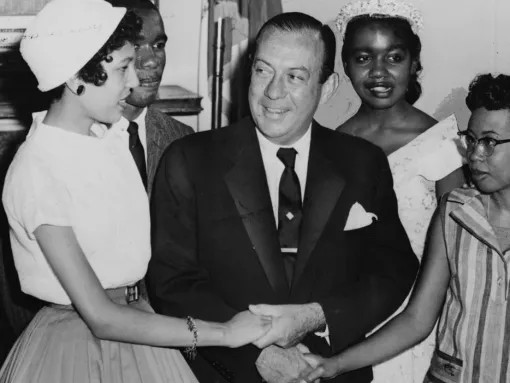
Minnijean Brown, Elizabeth Eckford, Carlotta Walls, Mayor Wagner, Thelma Mothershed, Gloria Ray, Terrance Roberts, Ernest Green, Melba Pattilo, Jefferson Thomas.
On September 23, 1957 in Little Rock, Arkansas, these nine African-American students quietly slipped into Central High School through the side door with the assistance of the city’s police, while an angry white mob numbering 1,000 swarmed the front of the school to await their arrival. Upon learning of their entry, the…

More than sixty-five years after Brown v. Board of Education, the promise of equal access to quality education remains unfulfilled. School expulsions and suspensions are among the best predictors of who will drop out of high school and African American students are three more likely to be suspended or expelled than their white peers.
In January 2014, the Department of Education and Department of Justice issued watershed guidance on school discipline with the intent to …
The Civil Rights Act of 1964 was signed into law by President Lyndon Johnson on July 2, 1964. The Act prohibited discrimination in public places, provided for the integration of schools and other public facilities and made employment discrimination illegal based on race, color, religion, sex or national origin. The document was the most sweeping civil rights legislation since Reconstruction. As we commemorate the anniversary of the Civil Rights Act, we have an opportunity to teach and learn…
Introduction
The right to freedom of religion is so central to American democracy that it was enshrined in the First Amendment to the U.S. Constitution.
The Founding Fathers wrote the First Amendment in response to two centuries of state-sponsored religious conflict and oppression in America, and with a keen understanding of the religious persecution in European nations resulting from official state religions and religious wars.
Recognizing the unique and intimate nature…
From Bloody Sunday to the Voting Rights Act: How One Day Changed the Course of Civil Rights History
March 7, 1965 — a day that would become known as Bloody Sunday — forever changed the course of American history. That day the nation’s attention turned to Selma, Alabama, where state troopers and a sheriff’s posse brutally attacked 575 demonstrators attempting to march peacefully to Montgomery. The marchers had gathered for two purposes: to advocate for voting…