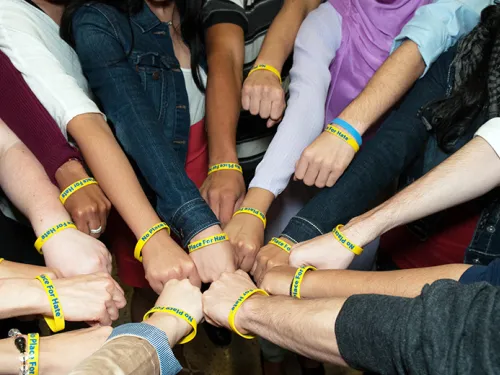




New York, NY, March 17, 2021 ... In response to historic increases in anti-Chinese and anti-Asian American and Pacific Islander incidents and assaults, ADL (the Anti-Defamation League), the world’s leading anti-hate organization and Committee of 100, a non-profit U.S. leadership organization of prominent Chinese Americans, issued the following joint statement:
“We are united with all of our Asian American brothers and sisters in standing up against hate, xenophobia and violence…
121 Results

What Educators and Family Members Can DoToday, local, national or international tragedies happen so frequently that they can feel almost commonplace. When a hate crime, mass shooting, act of terrorism or other terrible and hate-inspired event occurs, one of the first questions many people ask is, what should we tell the children? How can we explain to them what has happened? Despite our best efforts to protect youth from the details of hate-motivated events, we can never assume that they are…
Debra Messing hosted first virtual ADL In Concert Against Hate, which recognized a Holocaust survivor, educators and a 4th grade activist who are fighting injustice New York, December 7, 2020 … ADL (the Anti-Defamation League) recognized two individuals and one group for their extraordinary courage and compassion when confronted with injustice and extremism as part of the 26th annual ADL In Concert Against Hate.
This year’s event, which was held virtually on Dec. 6, was hosted…
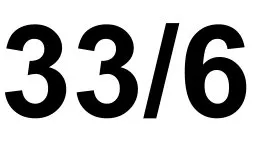
The number 33 is used by Ku Klux Klan adherents to signify the Ku Klux Klan. Since the 11th letter of the alphabet is K, three Ks signify "KKK" or the Ku Klux Klan. When using this reference, Klan members will frequently add the number 6 at the end, as in 33/6, because they think the Klan is currently in its sixth historical "era." Less commonly, some holdouts may still use the numeric code 33/5. Additional Images:
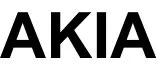
AKIA is Ku Klux Klan shorthand for "A Klansman I Am." It is related to another Klan acronym, AYAK ("Are You A Klansman?"). These are among the many acronyms developed by the Second Ku Klux Klan that emerged in 1915. Although the Second Ku Klux Klan did not survive, much of its terminology and many of its rituals did, and later Klan groups freely used them. Additional Images:
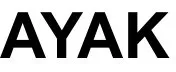
AYAK is Ku Klux Klan shorthand for "Are You A Klansman?" It is related to another Klan acronym, AKIA ("A Klansman I Am"). These are among the many acronyms developed by the Second Ku Klux Klan that emerged in 1915. Although the Second Ku Klux Klan did not survive, much of its terminology and many of its rituals did, and later Klan groups have freely used them. Additional Images:
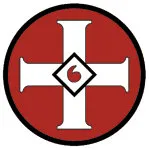
ALTERNATE NAMES: Ku Klux Klan, MIOAKGroup Status: Active (in that there are many active Ku Klux Klan groups)
For the past century, the primary symbol related to Ku Klux Klan groups (other than Klan robes themselves) is what Klan members may call the MIOAK (an acronym for "Mystic Insignia of a Klansman"). It is more commonly referred to as the "Blood Drop" Cross. It appears as a square white cross in black outline against a circular red background. In the middle of the cross is what appears…
ALTERNATE NAMES: Ku Klux Klan, MIOAK
Read more about Blood Drop Cross
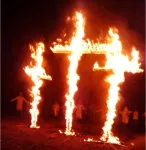
The image of the burning cross is one of the most potent hate symbols in the United States, popularized as a terror image by the Ku Klux Klan since the early 1900s. Cross-burnings (called "cross-lightings" by Ku Klux Klan groups, to make it seem as if they are not destroying a Christian cross) have long been used as a traditional symbol by Klan groups, used both in Klan rituals as well as in attempts to intimidate and terrorize victims of Klan groups. So widely associated with racial…

ALTERNATE NAMES: For God, Race and NationFGRN is a Ku Klux Klan acronym for "For God, Race and Nation," a common Klan slogan. It is one of a number of slogans, codes and rituals created by the Second Ku Klux Klan in the early 20th century. That Klan did not survive, but many of its codes and rituals were adopted by later Klan groups. In acronym form, the slogan is used primarily as a Klan identifier, typically appended at the end of on-line messages and postings. Additional Images:
ALTERNATE NAMES: For God, Race and Nation
Read more about FGRN

ITSUB is a Ku Klux Klan acronym for "In The Sacred Unfailing Being," a reference to God. It is one of many Klan acronyms created by the Second Ku Klux Klan that emerged in 1915. That Klan did not survive, but subsequent Ku Klux Klan groups continued many of its rituals and codes. Today, ITSUB has no real meaning or particular purpose and is typically used by Klan group members in on-line messages or posts solely as a way to identify themselves with the Ku Klux Klan. This has been the fate of a…

KABARK is a Ku Klux Klan acronym for "Konstantly Applied By All Regular Klansmen." It is one of many acronyms and codes developed by the Second Ku Klux Klan in the early 20th century. The Second Ku Klux Klan did not survive, but later Klan groups continued many of its codes and rituals. Today, KABARK is essentially meaningless and only used as a "sign off" in on-line messages by Klan group members, along with several other similar archaic acronyms. Additional Images:
KIGY is Ku Klux Klan shorthand for "Klansman I Greet You." It is one of many acronyms developed by the Second Ku Klux Klan that emerged in 1915. Although the Second Ku Klux Klan did not survive, much of its terminology and many of its rituals did, and later Klan groups freely used them. Additional Images:

KLASP is a Ku Klux Klan acronym for "Klannish Loyalty, A Sacred Principle." It is one of many Klan acronyms created by the Second Ku Klux Klan that emerged in 1915. That Klan did not survive, but subsequent Ku Klux Klan groups continued many of its rituals and codes. Today, KLASP has no real meaning or particular purpose and is typically used by Klan group members in on-line messages or posts solely as a way to identify themselves with the Ku Klux Klan. This has been the fate of a number of…
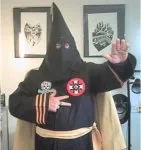
From its beginnings in the 1860s, the Ku Klux Klan has employed a variety of salutes and hand signs both public and private. Most of the hand signs and gestures used by the first and second Ku Klux Klans have fallen by the wayside over the years, except for the Klan salute, which dates back to 1915. It resembles a Nazi salute (which some Klan members will also use), except that it is performed with the left arm. Often Klan members will separate the fingers of their hand when making the salute …
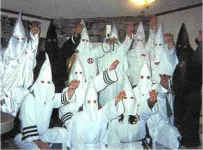
The hood and robes of Ku Klux Klan members are the most visible Klan symbol of all. Read about the history and current meanings behind the Klan’s robes.
LOTIE is a Ku Klux Klan abbreviation for a "Lady Of The Invisible Empire," i.e., a female Klan member. It is one of many codes, phrases and rituals created by the Second Ku Klux Klan in the early 20th century. The Second Klan did not survive, but later Klan groups adopted many such codes and rituals, including LOTIE. Additional Images:
New national data reveals deadliest year on record for hate crimes, even as fewer agencies reported data New York, NY, November 16, 2020 … ADL (the Anti-Defamation League) today called on Congress and law enforcement agencies across the U.S. to improve data collection and reporting of hate crimes in response to newly released FBI data for 2019. The data reveals a harrowing trend of increasing hate crimes being reported in the United States, even as fewer law enforcement agencies…
ALTERNATE NAMES: NSSANon Silba Sed Anthar is a Ku Klux Klan slogan intended to mean "Not Self, But Others." It looks like Latin but is a mix of Latin and Gothic. Occasionally it appears in acronym form as NSSA. The phrase is one of many phrases, codes and rituals developed by the Second Ku Klux Klan in the early 20th century. The Second Klan did not survive, but later Klan groups adopted many of its trappings. This is one of the more commonly used Klan slogans. Additional Images:
ALTERNATE NAMES: NSSA
Read more about Non Silba Sed Anthar
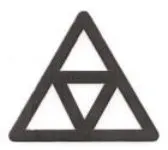
The triangular Ku Klux Klan symbol looks like a triangle within a triangle but is actually three letter K's aligned in a triangle and facing inwards.

November 06, 2020 THE WEEK’S BIG 3
As the country waited anxiously for all the votes to be counted in the U.S. presidential election, ADL urged calm and patience and reiterated our longstanding calls that every vote counts and every vote must be counted. Marjorie Taylor Greene, a Republican candidate from Georgia who has espoused the antisemitic QAnon conspiracy theory and employed racist rhetoric during her congressional campaign was elected to the House of Representatives. And ADL…