
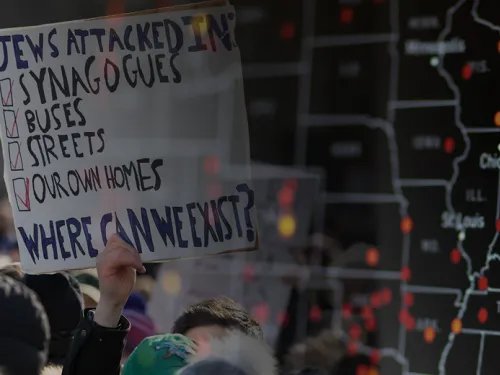



Remarks as delivered June 27th, 2024 Thank you- I join you all here this morning on behalf of ADL, the oldest anti-hate organization in the United States, alongside my good friend Marc Morial, President of the National Urban League, and our partners - Assembly members Brian Cunningham, Nily Rozic, Grace Lee, Jennifer Rajkumar and Pastor Johnnie Green. In addition. We are very grateful to Dr. Hazel Dukes of the NY NAACP, an icon of the civil rights movement for lending her strong words of…
46 Results

Tips and guidance for helping K-12 schools encourage students to become civically engaged, provide safety and protection for all students, and adhere to students’ First Amendment rights.

The mission of ADL’s Task Force on Middle East Minorities is to bring international attention to the human rights offenses committed against minority communities in the Middle East. The Task Force consists of regional and topical experts who serve as an advisory body to augment ADL’s work in protecting vulnerable minorities by identifying, elevating, and educating on emerging human rights issues in the Middle East.
The task force is comprised of leading scholars, experts, and…
August 21 marked the 53rd anniversary of the 1969 al-Aqsa Mosque arson and the ongoing disinformation campaigns scapegoating Jews and Israel for the attack. Although Israeli authorities promptly arrested, tried, and convicted the culprit, Denis Michael Rohan – a Protestant extremist from Australia who believed his actions would prompt the Second Coming of Jesus – Middle Eastern outlets have been publishing inaccurate reports of the event to this day. In a blog published last month,…
August 21 marks the 53rd anniversary of a terrible attack against an Islamic holy site, when a Protestant extremist from Australia named Denis Michael Rohan set fire to the al-Aqsa Mosque in Jerusalem, destroying large parts of the site and irreplaceable artifacts.
Rohan’s crime should rightly be widely condemned and the loss commemorated even five-plus decades later. It is important to note that Rohan, who believed his actions would prompt the Second Coming of Jesus, was…
New York, NY, August 5, 2022 … ADL (Anti-Defamation League) Task Force on Middle East Minorities released the following statement in response to the intensified campaign by the Iranian regime targeting Iran’s Baha’i minority: “We condemn the recent attacks targeting Iran’s vulnerable Baha’i community, and the July 31 statement by Iran’s Ministry of Intelligence which alleged that Baha'is are spies for foreign countries. This is part of the Islamic…
Read ADL Letters, testimony and comments sent to Congress and Federal Agencies.
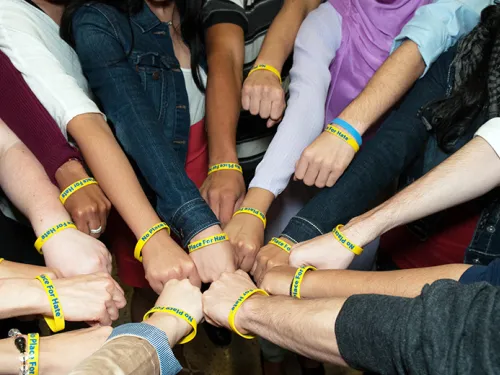
New York, NY, October 5, 2021 … Thousands of individuals from all walks of life will join together in communities across the country, both in-person and virtually, with an aim to “Fight Hate for Good” in ADL’s (the Anti-Defamation League’s) Walk Against Hate.
Scheduled to take place on Sunday, October 10 in communities across the country, the annual event brings together families, friends, colleagues, teammates, community groups, students, educators and more…
New York, NY, June 23, 2021 … ADL (the Anti-Defamation League) today welcomed the Supreme Court’s decision in Mahanoy v. B.L., an 8-1 ruling that a school violated the free speech clause of the First Amendment when they suspended a student from the cheerleading team for a vulgar social media post made off-campus and outside of school hours.
“This is an important win for the free speech rights of all U.S. students,” said ADL Legal Affairs Chair Joe Berman. …
February 22, 2021 Social media platforms have received the lion’s share of attention for enabling users to spread hate and disinformation and plan and incite violence and terrorist acts. Flying under the radar are infrastructure providers like Epik, a domain registrar and web hosting company that works with nearly 750,000 websites and is ranked among the 50 largest web hosts. A domain is the address of a website you type into the URL bar of an internet browser. Domain registrars are…
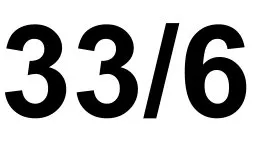
The number 33 is used by Ku Klux Klan adherents to signify the Ku Klux Klan. Since the 11th letter of the alphabet is K, three Ks signify "KKK" or the Ku Klux Klan. When using this reference, Klan members will frequently add the number 6 at the end, as in 33/6, because they think the Klan is currently in its sixth historical "era." Less commonly, some holdouts may still use the numeric code 33/5. Additional Images:
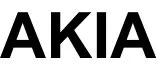
AKIA is Ku Klux Klan shorthand for "A Klansman I Am." It is related to another Klan acronym, AYAK ("Are You A Klansman?"). These are among the many acronyms developed by the Second Ku Klux Klan that emerged in 1915. Although the Second Ku Klux Klan did not survive, much of its terminology and many of its rituals did, and later Klan groups freely used them. Additional Images:
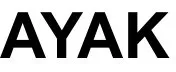
AYAK is Ku Klux Klan shorthand for "Are You A Klansman?" It is related to another Klan acronym, AKIA ("A Klansman I Am"). These are among the many acronyms developed by the Second Ku Klux Klan that emerged in 1915. Although the Second Ku Klux Klan did not survive, much of its terminology and many of its rituals did, and later Klan groups have freely used them. Additional Images:
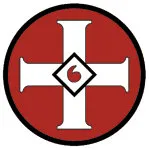
ALTERNATE NAMES: Ku Klux Klan, MIOAKGroup Status: Active (in that there are many active Ku Klux Klan groups)
For the past century, the primary symbol related to Ku Klux Klan groups (other than Klan robes themselves) is what Klan members may call the MIOAK (an acronym for "Mystic Insignia of a Klansman"). It is more commonly referred to as the "Blood Drop" Cross. It appears as a square white cross in black outline against a circular red background. In the middle of the cross is what appears…
ALTERNATE NAMES: Ku Klux Klan, MIOAK
Read more about Blood Drop Cross
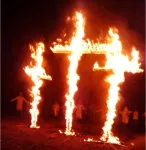
The image of the burning cross is one of the most potent hate symbols in the United States, popularized as a terror image by the Ku Klux Klan since the early 1900s. Cross-burnings (called "cross-lightings" by Ku Klux Klan groups, to make it seem as if they are not destroying a Christian cross) have long been used as a traditional symbol by Klan groups, used both in Klan rituals as well as in attempts to intimidate and terrorize victims of Klan groups. So widely associated with racial…

ALTERNATE NAMES: For God, Race and NationFGRN is a Ku Klux Klan acronym for "For God, Race and Nation," a common Klan slogan. It is one of a number of slogans, codes and rituals created by the Second Ku Klux Klan in the early 20th century. That Klan did not survive, but many of its codes and rituals were adopted by later Klan groups. In acronym form, the slogan is used primarily as a Klan identifier, typically appended at the end of on-line messages and postings. Additional Images:
ALTERNATE NAMES: For God, Race and Nation
Read more about FGRN

ITSUB is a Ku Klux Klan acronym for "In The Sacred Unfailing Being," a reference to God. It is one of many Klan acronyms created by the Second Ku Klux Klan that emerged in 1915. That Klan did not survive, but subsequent Ku Klux Klan groups continued many of its rituals and codes. Today, ITSUB has no real meaning or particular purpose and is typically used by Klan group members in on-line messages or posts solely as a way to identify themselves with the Ku Klux Klan. This has been the fate of a…

KABARK is a Ku Klux Klan acronym for "Konstantly Applied By All Regular Klansmen." It is one of many acronyms and codes developed by the Second Ku Klux Klan in the early 20th century. The Second Ku Klux Klan did not survive, but later Klan groups continued many of its codes and rituals. Today, KABARK is essentially meaningless and only used as a "sign off" in on-line messages by Klan group members, along with several other similar archaic acronyms. Additional Images:

KIGY is Ku Klux Klan shorthand for "Klansman I Greet You." It is one of many acronyms developed by the Second Ku Klux Klan that emerged in 1915. Although the Second Ku Klux Klan did not survive, much of its terminology and many of its rituals did, and later Klan groups freely used them. Additional Images:

KLASP is a Ku Klux Klan acronym for "Klannish Loyalty, A Sacred Principle." It is one of many Klan acronyms created by the Second Ku Klux Klan that emerged in 1915. That Klan did not survive, but subsequent Ku Klux Klan groups continued many of its rituals and codes. Today, KLASP has no real meaning or particular purpose and is typically used by Klan group members in on-line messages or posts solely as a way to identify themselves with the Ku Klux Klan. This has been the fate of a number of…