








Americans with disabilities are a group of approximately 40.7 million people that today lead independent, self-affirming lives and who define themselves according to their personhood—their ideas, beliefs, hopes and dreams—above and beyond their disability. Since the mid 1900s, people with disabilities have pushed for the recognition of disability as an aspect of identity that influences the experiences of an individual, not as the sole-defining feature of a person. People with…
305 Results
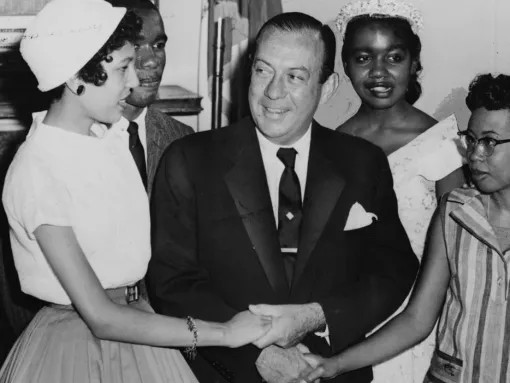
Minnijean Brown, Elizabeth Eckford, Carlotta Walls, Mayor Wagner, Thelma Mothershed, Gloria Ray, Terrance Roberts, Ernest Green, Melba Pattilo, Jefferson Thomas.
On September 23, 1957 in Little Rock, Arkansas, these nine African-American students quietly slipped into Central High School through the side door with the assistance of the city’s police, while an angry white mob numbering 1,000 swarmed the front of the school to await their arrival. Upon learning of their entry, the…
The Civil Rights Act of 1964 was signed into law by President Lyndon Johnson on July 2, 1964. The Act prohibited discrimination in public places, provided for the integration of schools and other public facilities and made employment discrimination illegal based on race, color, religion, sex or national origin. The document was the most sweeping civil rights legislation since Reconstruction. As we commemorate the anniversary of the Civil Rights Act, we have an opportunity to teach and learn…
What was Kristallnacht (kris'·tahl·nockt)?
Kristallnacht, the "Night of Broken Glass," was a wave of violent pogroms against Jews throughout Germany and Austria that took place on November 9-10, 1938. On the night of November 9th, the Gestapo (Nazi State Police) informed local police by telegram about the actions against Jews and their synagogues that would be taking place throughout Germany, instructing them not to interfere with what was happening. During these two nights,…
For Educators