




Unpack and explore historical and contemporary developments, issues and challenges regarding Israel, the Israeli-Palestinian conflict, and the pursuit of peace. Founding of IsraelZionismAnti-ZionismThe Balfour Declaration: 1917The British MandateUnited Nations Partition Plan: 1947Founding of the State of Israel:1948NakbaIsrael-Arab / Israeli-Palestinian ConflictWar of Independence: 1948-1949The Green LineArab Economic BoycottSix Day War: 1967Yom Kippur War: 1973Lebanon War: 1982-1983First…
1245 Results
In December 1987, collective Palestinian frustration erupted in the popular uprising against Israeli rule known as the Intifada, or “shaking off.” At first a spontaneous outburst, the Intifada developed into a well-organized rebellion. Masses of civilians attacked Israeli troops with stones, axes, Molotov cocktails, hand grenades, and firearms supplied by Fatah, killing and wounding soldiers and civilians. Israeli troops, trained for combat, were not prepared to fight this kind of…
The mission of ADL is to stop the defamation of the Jewish people and to secure justice and fair treatment to all.
The murder of six million Jews and millions of others carried out by the Nazis and their collaborators was the largest recorded genocide in modern history. Absolutely no comparison can be made between the complex Israeli-Palestinian conflict and the atrocities committed by the Nazis against the Jews.
While one can criticize Israel’s treatment of the Palestinians, in contrast to the Holocaust, there is not now, nor has there been, a significant Israeli ideology, movement, policy or…
U.S. foreign policy on Israel involves many complex issues, actors and considerations and cannot be ascribed to a “powerful Jewish lobby.”
As citizens of the United States, advocacy by American Jews is an appropriate exercise of American democracy and reflective of the Jewish community’s commitment to American democratic ideals. The American Jewish community’s active engagement in the political process is mirrored in the activism of other community…
Israel is often unfairly accused of various forms of “washing” - including pinkwashing, greenwashing, and veganwashing, terms used to dismiss or deny characteristics of Israeli society that reflect its democratic and liberal values in an effort to delegitimize the State and its policies.
“Pinkwashing,” a combination of the words “pink” and “whitewashing,” was originally coined by critics of corporations that marketed products and services…
Description of the 2021 Israel-Hamas Conflict
Anti-Zionism is opposition to Zionism, the movement for the self-determination and statehood of the Jewish people in their ancestral homeland, the land of Israel. Anti-Zionism is often expressed, explicitly or implicitly in the rejection of Jewish nationhood and the right to self-determination; the vilification of individuals and groups associated with Zionism; and the downplaying or negation of the historic and spiritual Jewish connection to the land of Israel.
Anti-Zionism is…
UPDATE: Following a series of compounding internal and leadership squabbles, the National Justice Party (NJP) dissolved in late 2023. ADL has not documented any NJP activity since the dissolution. However, the National Organization for Vital Action (NOVA), a splinter group comprised of some former members of NJP that formed in 2024, has taken its place. Key Points: The National Justice Party (NJP) was formed in August 2020 by a number of well-known white supremacists, most of whom attended the…
Some claim Israel is committing “ethnic cleansing” against the Palestinians. While there is no precise definition of ethnic cleansing under international law, the charge suggests that Israel is systematically working to rid its territory of Palestinians, including Israeli Arab citizens, through force or intimidation tactics in order to create a homogeneous society. This is a fundamentally inaccurate accusation.
In recent decades, there have been numerous episodes of ethnic…
Some activists have presented the fight against Israel, and for Palestinians rights, as the same as the fight for racial justice in the United States. While it is understandable to attempt to make sense of international events through the prism of our own domestic context, the specifics of the Israeli-Palestinian conflict do not lend themselves to exact comparisons with the American experience of systemic racial inequality.
Distinct from issues in the United States, the root of the…
It is not uncommon today to see critics of Israel accusing it of being an apartheid state. Whether such a description is being used to describe Israeli policies towards Palestinians in the West Bank and Gaza Strip, or towards Arab citizens of Israel, the label is inaccurate, offensive, and often used to delegitimize and denigrate Israel as a whole. Moreover, the use of this inaccurate and highly charged label is also counterproductive to resolving issues related to injustices…
The term “settler colonialism” conjures historical memories of exploitative white European empires militarily invading lands in the Middle East, Asia and Africa[i], implanting their citizens in colonies through the use of force, subjugating the native and indigenous populations and stealing their natural resources.
Many anti-Israel activists and academics use the term “settler colonialism” to describe the political and demographic changes over the last 150 years in…
Once largely relegated to white supremacist rhetoric, “The Great Replacement” has made its way into mainstream consciousness in the past several years. From the chants of “Jews Will Not Replace Us” on the University of Virginia campus to then-U.S. Rep. Steve King’s tweeted protest, “We can’t restore our civilization with somebody else’s babies,” to Fox News’ Tucker Carlson’s complaints that the Democratic party is attempting to …
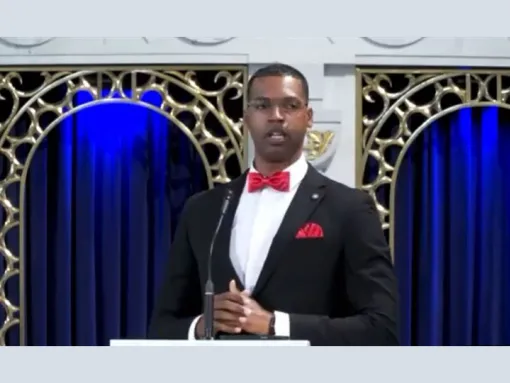
Rizza Islam speaking at the Nation of Islam’s 2021 Saviours’ Day conference at Mosque Maryam in Chicago.
Key Points:
Ronnie Steven “Rizza” Islam is a member of the Nation of Islam
Mr. Islam is also a social media influencer, with more than 500K followers
He regularly posts antisemitic, anti-LGBTQ and anti-vaccine rhetoric
Mr. Islam also espouses a range of conspiracy theories
Background:
Ronnie Steven &ldquo…
What is the IHRA Working Definition of Antisemitism? In 2016, the International Holocaust Remembrance Alliance (IHRA), comprised of 31 member-states, including the United States, formally adopted the IHRA Working Definition of Antisemitism (“the IHRA Definition”). The IHRA Definition, initially published by a European Union agency in 2005, has been used by the U.S. State Department since 2010 and by the U.S. Department of Education since at least 2019. It was embraced in the…
Key PointsThe Goyim Defense League is a loose network of individuals who promote vitriolic antisemitism and white supremacist themes through online activity, propaganda distributions, and real-world actions.The group includes a few dozen core influencers and live streamers, a larger group of supporters willing to engage in on-the-ground activity, and tens of thousands of online followers.GDL operates GoyimTV, a video platform that streams antisemitic content, with monetized livestreams funding…

Key Points NSC-131 is a neo-Nazi group based in the New England region.Members consider themselves soldiers at war with a hostile, Jewish-controlled system that is deliberately plotting the extinction of the white race.NSC-131 seeks to form an underground network of white men who are willing to fight against their perceived enemies through localized direct actions.Members espouse racism, antisemitism and intolerance via the Internet, propaganda distributions and the use of…
Key Points
Black Hebrew Israelites are not the same as Black Jews or Jews of color.
Not all Black Hebrew Israelite organizations are antisemitic or extremists.
The Black Hebrew Israelite movement is divided into organizations or sects that operate semi-independently across the United States.
Black Hebrew Israelites believe that they are the true Israelites and that the Twelve Tribes of Israel are people of color.
Popular activities include street teachings and public speaking…
The “Oslo Process” refers to the Israeli-Palestinian negotiating process begun in September 1993 which established a framework for resolving the conflict.
In August 1993, it was revealed that secret negotiations in Oslo, Norway between high-level Israelis and Palestinians had led to the first Israeli-Palestinian agreement. The talks, initiated months earlier under the auspices of the Norwegian Foreign Ministry, had begun informally with low level Israeli and Palestinian…