




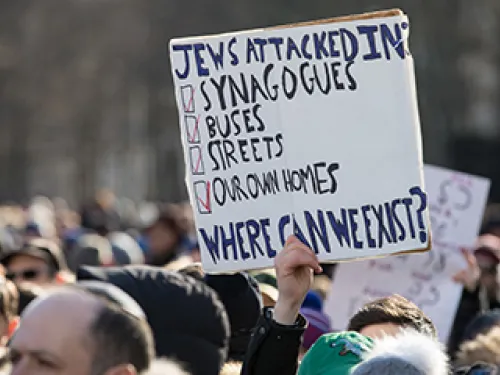





Learn tips on how to have conscientious discussions about this complex issue and how to avoid common pitfalls that could invoke antisemitism, bias or bigotry.
47 Results
ADL has developed resources to help you respond to antisemitic incidents and anti-Israel bias. Explore these tools and learn more.
Strategies on how to be prepared for antisemitic or anti-Israel situation on campus, based on real life incidents

View this page in Spanish Antisemitism is a topic that has been in the news and is something important to explore and understand. From news stories about vandalism and hate crimes, to celebrities spewing frightening claims and vitriol about Jewish people, to the antisemitic tropes we see in our social media feeds — antisemitism is all around us. What is Antisemitism?Antisemitism refers to prejudice, discrimination, or hostility directed at Jewish people. It is generally based…
Read ADL Letters, testimony and comments sent to Congress and Federal Agencies.
The Pyramid of Hate illustrates the prevalence of bias, hate and oppression in our society. It is organized in escalating levels of attitudes and behavior that grow in complexity from bottom to top. Like a pyramid, the upper levels are supported by the lower levels; unlike a pyramid, the levels are not built consecutively or to demonstrate a ranking of each level. Bias at each level reflects a system of oppression that negatively impacts individuals, institutions and society…
What is the source of our free speech rights? Free speech rights emanate from the First Amendment to the U.S. Constitution[1] and from state constitutions. The U.S. Constitution limits the government’s ability to regulate speech based on content and it applies to all public colleges and universities. It serves as a floor, not a ceiling. State constitutions may grant more robust free speech rights than the U.S. Constitution, but never fewer. Is there a distinction between private and…