





February 14, 1896
Publication of Theodor Herzl's treatise "The Jewish State"
August 29, 1897
Opening of the First Zionist Congress at Basel, Switzerland
November 2, 1917
Issuing of Boycott (on the Jewish community of Palestine)
July 22, 1946
Irgun bombs King David Hotel
February 14, 1947
Britain gives UN responsibility for Palestine
November 29, 1947
UN Partition Plan approved (Resolution 181)
May 14, 1948
Declaration of the State of Israel
…
181 Results
Advocating to Elected Officials
Advocating to the Media
Advocating on Campus

For Educators Because discussions of race and racism are part of our public discourse, educators feel a sense of responsibility to bring these topics into their classrooms—because young people want to be part of the conversation and should be. If handled effectively, these discussions provide opportunities for timely learning. Below are suggestions and strategies for having classroom conversations with young people about race and racism. Prior to these discussions and…
Most Americans’ perceptions of the Middle East conflict come from the mass media. Some media – especially large-circulation daily newspapers, network television and wire services – have correspondents based in Israel and continue to devote considerable attention to the Mideast. This is not surprising considering the intensive U.S.involvement in the peace process, America’s substantial interests in the region, and the continuing strong ties between the U…
Flag
The colors blue and white were chosen according to the colors of the ‘Tallit’ – the Jewish prayer shawl. The Star of David appearing in the center of the flag has been a Jewish symbol for hundreds of years.
State Emblem
The official emblem of the State of Israel is the Menorah – a candelabrum, whose shape is derived from the sage plant (Moria). In certain species of the plant, the leaves branch out in a way that resembles the candelabrum that stood in the…
Early Childhood Question Corner For Educators | For Parents, Families, and Caregivers Young children can be blunt and direct as they notice and talk about the differences they notice among people. That can sometimes make their parent or caregiver feel uncomfortable, especially in public settings. Remember that young children’s initial observations about difference do not intend to be hurtful. Instead, it shows their developing curiosity and awareness of the diversity in the world in…
Early Childhood Question Corner For Educators | For Parents, Families, and Caregivers There is no need to wait until children ask questions about differences to begin conversations. However, these discussions will have the greatest impact when they follow from children’s interests, and when they are appropriate in length, frequency and content relative to children’s intellectual and emotional capacity. Louise Derman-Sparks (1989) writes that awareness of, and talking about,…
Early Childhood Question Corner For Educators | For Parents, Families, and Caregivers Many adults think that talking with children about our differences teaches prejudice. In Anti-Bias Curriculum, Louise Derman-Sparks (1989) debunks that myth and writes that talking about differences does not increase prejudice in children. Whether or not adults discuss differences with children, all children begin to notice differences among people as part of their natural development. It is the messages…
Early Childhood Question Corner For Educators | For Parents, Families, and Caregivers Although children are not born with prejudice, by early childhood they have already acquired stereotypes or negative attitudes toward those that they perceive as “others.” An article in The Buffalo News reports that about 85 percent of the brain develops between ages 3 and 5, and that impressions and ideas formed between ages 2 and 4 are lasting (Lessons in Respect, 2003). Researchers tracking the…

Early Childhood Question Corner
Common themes appear in holidays and celebrations across many cultures. By connecting themes, as suggested in the Question Corner installment "How can I plan inclusive holiday celebrations?" you can show children that holidays and celebrations are an expression of cultural and religious pride, and help them understand the commonality of certain human feelings, celebrations and their meaning. For example, by trying the following activity, Looking…
On July 1, 2019, the International Atomic Energy Agency (IAEA) announced that Iran had exceeded its agreed-to limit on the volume of its stockpile of enriched uranium, putting heightened concerns about an Iranian nuclear weapons program back in the headlines. Days later, Iran proclaimed it had enriched uranium to about 4.5% purity, again breaching prior agreed to levels. Since then, Iran has announced numerous other accelerations of its nuclear program that specifically exceed…
Early Childhood Question Corner For Educators | For Parents, Families, and Caregivers In Teacher they called me a ____!, Dr. Debra A. Byrnes defines prejudice as preconceived ideas about people “perceived as being different, due to race, religion, culture, gender, disabilities, appearance, language, sexual orientation, or social status” (1995, 3). She explains that a large body of research (Brown,1972; Byrnes & Kiger, 1992; Milner, 1975; Williams & Orland, 1976)…
Early Childhood Question Corner For Educators | For Parents, Families, and Caregivers Children’s outdoor play offers many opportunities to teach and reinforce anti-bias behavior. To get you started, incorporate some of the below tips excerpted from Bias-Free Foundations: Early Childhood Activities for Educators (2005, 28): Take advantage of these opportunities by helping children to learn skills such as taking turns, sharing toys and inviting new children to play. For example,…
Early Childhood Question Corner For Educators | For Parents, Families, and Caregivers The early childhood program environment should look and feel welcoming for all children and should reflect the diverse world in which we live. In addition to being bright, colorful, safe and clean, it should include children’s artwork and show the diversity of the world through the program’s abundant supply of age-appropriate toys, dolls, books, magazines , pictures and musical instruments…
For Educators | For Parents, Families, and Caregivers Winter is a festive time of year because so many holidays are celebrated by people from different religions, cultures and races. We spend time with family and friends, connect with our faith or culture, give and receive gifts and enjoy special foods and treats. However, this time of year—especially in schools and whether it's in-person, online or hybrid—can be a time where some children can feel uncomfortable, excluded, insulted…
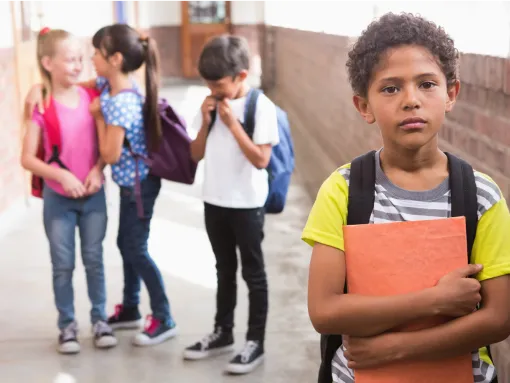
October is National Bullying Prevention Month
National Bullying Prevention Month is an opportunity to reflect on the classroom and school culture and assess the extent to which bullying is part of that culture. It is a time to examine best practices when it comes to creating respectful school environments that foster inclusion and respect. The large body of research on effective responses to name-calling and bullying concurs that schools and other educational institutions can best…

Teach and commemorate the culture, traditions and history of Asian American and Pacific Islander people in the United States in school, communities and at home.

Use these resources to honor women around the world, explore women’s achievements and struggles throughout history, and acknowledge women’s contributions to our society.

For Educators In many of ADL’s lesson plans and activities, students are challenged to explore and articulate their personal feelings about sensitive topics including segregation, discrimination, and the value of diverse school communities. Talking about themes related to diversity requires that students demonstrate maturity and compassion for others. In conjunction with social justice curricula, it is therefore recommended that teachers use service learning, conflict resolution,…
Literature is a powerful vehicle for helping children understand their homes, communities and the world. Even before young children can read, family members, childcare providers and teachers read them stories about people in faraway places, sometimes from the distant past and sometimes about people whose lives are similar to their own. The impressions and messages contained in these stories can last a lifetime.
Books, at their best, invite children to use their imaginations, expand their…